 Full Catalog PDF

Key Takeaways:
- Not every driveway drainage problem needs a trench drain. Diagnosing where the water comes from and where it goes determines the right solution.
-
Redirecting downspouts and correcting soil grade resolve a significant number of driveway drainage issues without any excavation.
-
A catch basin or drywell is often the right middle-ground solution for concentrated pooling at a single low point.
-
When a trench drain is the right answer, choosing the correct load rating, channel type, and grate style matters as much as the installation itself.
If water is finding its way into your garage or pooling at the base of your driveway after every rain, you might assume you need a trench drains. Sometimes that's exactly right, but for a lot of driveway drainage problems it's more than the situation actually calls for.
The challenge is that driveways are uniquely unforgiving surfaces. Unlike lawn or garden areas, pavement doesn't absorb anything. Every drop of rain becomes runoff with nowhere to go except toward whatever is lowest, which on most residential properties means the garage or the foundation. Many driveways are built with a slight slope toward the garage, downspouts discharge onto or alongside the surface, and yard runoff from higher ground adds to the load.
This guide cuts through the assumptions and helps you find the right solution for what your driveway is actually dealing with.
What Happens If You Ignore Driveway Drainage Issues?
Driveway drainage problems tend to get worse as surfaces settle and soil erodes.
Water Entering the Garage
The most immediate consequence of poor driveway drainage is water sheeting under the garage door. Beyond the inconvenience, chronic moisture intrusion damages flooring, stored belongings, and the base of the garage structure over time. In attached garages, it creates a direct pathway for moisture to reach the home's interior.
Surface Damage
Standing water accelerates driveway deterioration. On concrete, it promotes cracking and spalling. On asphalt, it softens the base and leads to rutting and edge erosion. In freeze-thaw climates, water that infiltrates surface cracks freezes and expands, widening damage with every cold cycle.
Foundation Migration
Water that pools at the base of a driveway and has nowhere to go will eventually find a path toward the nearest structure. Driveways that run alongside or toward the house become a conduit for water to accumulate in the foundation zone.
Ice and Safety Hazards I
In cold climates, water that pools and refreezes on a driveway surface creates significant slip and liability risks. A drainage problem in October becomes a safety problem in January.
First, Diagnose Your Actual Problem
Before landing on any solution, spend time understanding exactly where the water is coming from and where it ends up. The answer to "do I need a trench drain" depends almost entirely on what you find here.
Where Is the Water Coming From?
- Are downspouts from the house or garage discharging onto or near the driveway surface?
-
Is yard runoff from higher adjacent ground crossing the driveway during rain?
-
Is the water coming from the driveway surface itself?
-
Is it a combination of all three?
Where Is It Going?
- Is it sheeting into the garage?
-
Is it pooling at a single low point mid-driveway or at the base?
-
Is it migrating toward the foundation along the driveway edge?
-
Is it running into the street or a neighbor's property?
Map this out before reaching for a solution. A downspout problem and a driveway slope problem look similar on the surface but call for completely different fixes.
4 Simple Fixes for Driveway Drainage
For many driveway drainage situations, the right solution is significantly less involved than a full trench drain. Start here.
Rerouting or Extending Downspouts
If roof runoff from the house or garage is a primary contributor, redirecting those downspouts away from the driveway may resolve the problem without any excavation at all. Flexible downspout extensions are inexpensive, installable in an hour, and surprisingly effective when downspout discharge is the root cause.
Run them far enough (at least six to ten feet from the driveway edge) and ensure the discharge point has somewhere productive to go.
Regrading the Driveway Edge or Adjacent Soil
If yard runoff is crossing the driveway from higher adjacent ground, correcting the grade of the soil alongside the driveway can redirect that water before it reaches the surface. A slight berm or swale running parallel to the driveway edge intercepts sheet flow and channels it away.
This is a low-cost, low-disruption fix that works well when neighboring grade is the primary water source.
A Catch Basin at the Base of the Driveway
For situations where water consistently pools at a single low point, a catch basin with a piped outlet is often a more targeted and cost-effective solution than a full linear drain. The basin sits at the low point, collects the pooling water, and pipes it to a suitable outlet away from the structure. It handles the problem where it concentrates rather than across the full driveway width.
A Drywell for Dispersal
Where running a pipe to a daylight outlet isn't practical, a drywell accepts collected water from a catch basin or downspout and disperses it gradually into the ground below the saturated surface layer. It's a good fit for lower-volume driveway drainage situations on properties where site constraints limit outlet options.
When a Trench Drain Is Actually the Right Answer
If any of the following apply, a linear drain system belongs in your plan.
- The driveway slopes toward the garage and the volume of runoff during heavy rain is too high for a point solution to keep up with.
-
Water sheets across the full width of the driveway during rain events. A catch basin handles a point, but a trench drain intercepts an entire flow path.
-
The property has no practical outlet for a catch basin pipe run and drywell capacity isn't sufficient for the volume.
-
Simpler fixes have already been tried and the problem persists. At that point, a linear drain is likely what the site actually needs.
Choosing the Right Trench Drain for a Driveway
Not all trench drains are built for driveway conditions. Getting this decision right upfront saves a costly reinstall down the road.
Load Rating Comes First
A driveway drain needs to handle vehicle weight repeatedly over its lifetime. Any trench drain installed across a driveway surface should be rated for vehicular traffic—at minimum Load Class C for passenger vehicles, Class D or higher for trucks or heavy equipment.
Match the System to Your Driveway's Layout
Driveways aren't one-size-fits-all, and neither are the drain systems designed for them. Vodaland's range covers most residential and light commercial driveway configurations.
Pre-Sloped vs. Neutral Channel
If your driveway has minimal natural grade or inconsistent slope, a pre-sloped channel builds the drainage gradient directly into the system—no relying on field conditions to move water toward the outlet. On sites with reliable consistent slope, a neutral channel gives you more flexibility in outlet placement.
Grate Style and Material
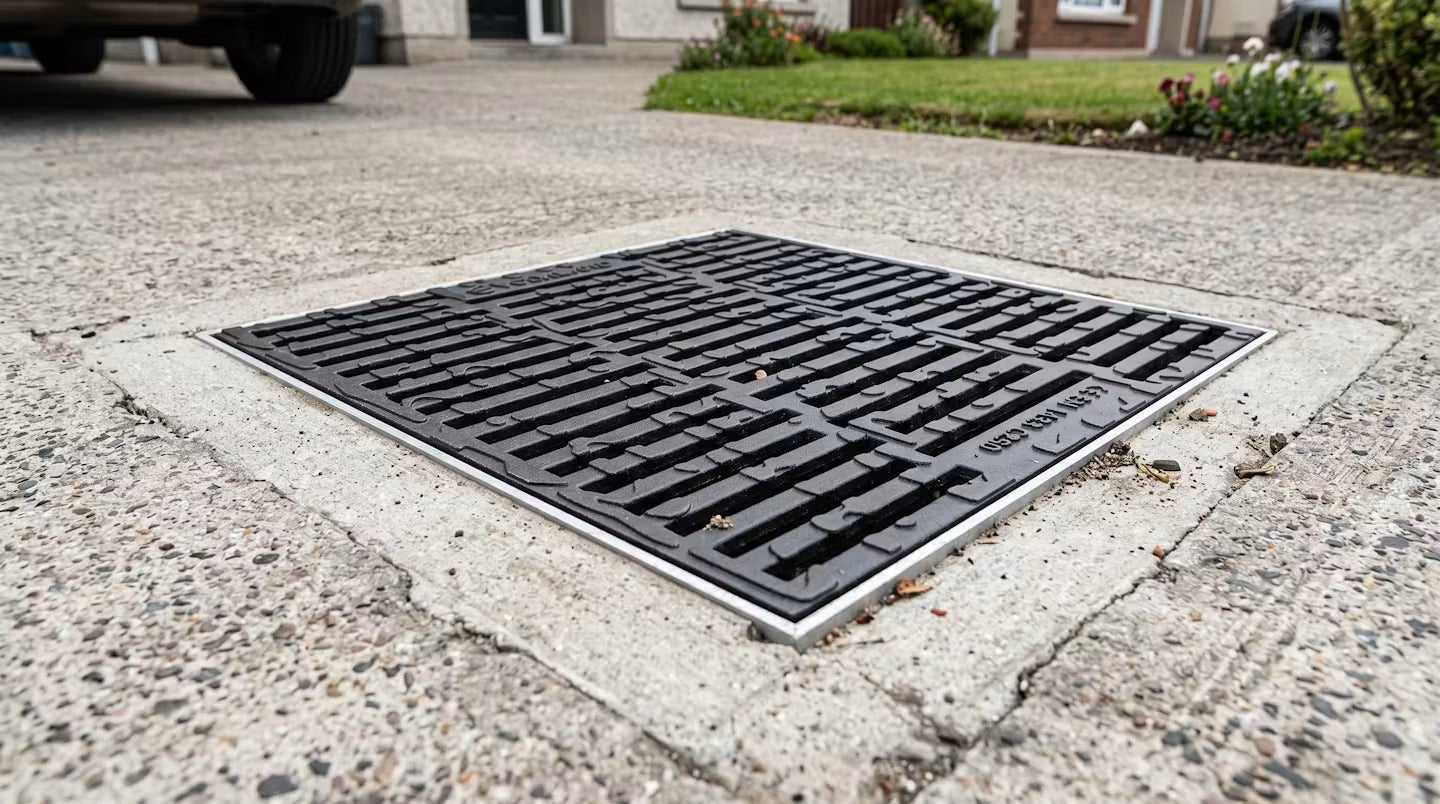
For most driveway applications, a galvanized or ductile iron grate rated for vehicle traffic is the practical standard. Stainless steel grates are worth considering for high-visibility installations where the finish will be seen. Heel-proof and ADA-compliant grate options are worth specifying anywhere the driveway is also used as a pedestrian surface.
Estimated Costs: Simple Fix vs. Trench Drain
Every site is different, but this framework gives you a realistic sense of where each solution lands before you commit to anything.
|
Solution |
Estimated DIY Cost |
Relative Difficulty |
|
$ |
Low |
|
|
Soil regrading |
$ – $$ |
Low |
|
$$ |
Low - Medium |
|
|
$$ |
Medium |
|
|
$ – $$ |
Medium - High |
Costs vary based on driveway size, outlet options, local material prices, and whether professional installation is involved.
Not Sure What Your Driveway Actually Needs? We Can Help.
Driveway drainage projects have a lot of variables: slope, surface type, outlet options, volume, and aesthetics all factor into which solution is the right fit. If you've read through this guide and still aren't sure whether a catch basin, a drywell, or a full trench drain system is the right call for your situation, our team can help you think it through.
Describe your driveway setup, where the water is coming from, and where it's going. We'll help you find the most practical solution for your project before you spend a dollar on materials.
Contact Vodaland's Designer Team for guidance planning your specific project.



Leave a comment
This site is protected by hCaptcha and the hCaptcha Privacy Policy and Terms of Service apply.