 Full Catalog PDF

Key Takeaways:
1. Airports manage some of the largest impervious surfaces in any infrastructure category, which makes flood risk a constant engineering challenge rather than an occasional concern.
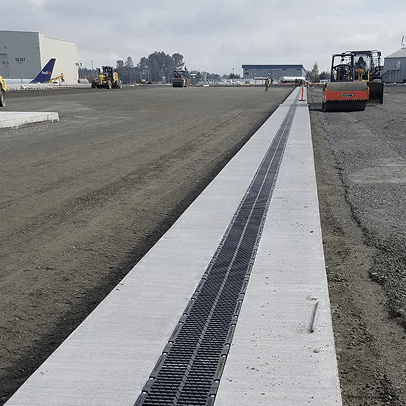
2. Runways and taxiways require Load Class F drainage systems built to handle the weight of commercial and military aircraft.
3. Concrete drainage systems are standard at this scale because they hold up under repeated heavy loads.
4. Airport drainage requires custom engineering specific to the site, the aircraft, and the regulatory standards involved.
Airports face a drainage challenge that's hard to overstate. Runways, taxiways, and tarmac areas cover huge stretches of impervious surface. And unlike most infrastructure, that surface has to stay nearly flat to keep aircraft operations safe.
There's no room for steep grading or dramatic slope changes. That means every drop of rain that falls has to be managed through precise, engineered drainage rather than relying on gravity and a generous incline. Add the sheer weight of the aircraft moving across that surface, and airport drainage becomes one of the more demanding applications in the entire industry.
3 Reasons Airports Are Vulnerable to Flooding
A few factors come together to make airport flooding a serious and recurring concern.
Massive Impervious Surface Area
A single runway can stretch over two miles long and well over 100 feet wide. None of that surface absorbs water. Every storm event generates significant runoff volume that has to be captured and moved somewhere, fast.
Flat Grading Requirements
Aircraft need consistent, predictable surfaces to operate safely. That means airport surfaces are graded with much gentler slopes than a typical driveway or parking lot, which limits how much natural gravity can do the work of moving water away. Drainage systems have to make up the difference.
High Stakes for Delays and Safety
Standing water on a runway directly affects flight operations. Flooding leads to ground stops, diverted flights, and in serious cases, safety incidents. The cost of poor drainage at an airport isn't measured in property damage the way it might be for a home or commercial site. It's measured in operational disruption and risk to passengers and crew.
Understanding Load Class F and Why It Matters Here
Drainage systems are rated by load class, which describes how much weight a system can handle without failing structurally. The scale runs from light pedestrian use up through heavy industrial and vehicular applications. At the very top sits Load Class F, the heaviest rating that exists.
Load Class F is built for environments where the weight involved goes well beyond standard truck or commercial traffic: aircraft, heavy industrial equipment, and similarly demanding loads.
A drainage system rated below this standard will crack, shift, or fail under the repeated weight of aircraft moving across it, which makes load class one of the first and most non-negotiable decisions in any airport drainage project.
Concrete Systems Built to Handle the Weight
At the load levels airports operate under, concrete drainage systems are the gold standard.
Concrete trench drains and channel systems distribute weight differently than lighter materials. Reinforced concrete channels resist the repeated compression and flex that comes from heavy aircraft rolling across them day after day, without the cracking or deformation that lighter-duty systems would experience under the same load.
The structural mass of concrete also holds up better against the constant vibration and impact associated with aircraft movement, which matters as much for long-term durability as the static load rating itself.
This is also why airport drainage projects rarely use off-the-shelf residential or even standard commercial-grade products. The demands are simply in a different category, and the systems need to be engineered to match.
Why Airport Drainage Requires Custom Engineering
No two airports have identical drainage needs. Site grading, regional rainfall patterns, aircraft types in regular use, and regulatory requirements all factor into what a given drainage system needs to do.
Airport drainage design typically involves detailed hydraulic modeling to predict how water will move across the surface during peak storm events, careful coordination with FAA standards and airport-specific regulatory requirements, and site-specific engineering that accounts for the exact load class, slope constraints, and outlet conditions involved.
This isn't a project where a standard product gets specified off a catalog page; it requires an engineered system designed for the specific site.
This is exactly the kind of project where Vodaland's approach shifts from product selection to engineering partnership. Projects at this scale require an engineer-designed system tailored to the site's specific load, grading, and regulatory requirements. Our team works directly with engineers and airport authorities to develop that solution rather than fitting the project into a standard product line.
If you're working on an airport or aviation-related drainage project, give us a call.
Why Drainage Failure at an Airport Is a Safety Issue
Standing water on an active runway creates immediate safety risks that go beyond inconvenience.
Hydroplaning Risk
Water on a runway surface reduces tire traction during landing and takeoff, increasing the risk of hydroplaning—a serious concern at the speeds involved in aircraft operations.
Reduced Visibility
Standing water can create reflective glare and spray during aircraft movement, reducing visibility for pilots and ground crews during critical operations.
Foreign Object Debris (FOD)
Poor drainage often correlates with debris accumulation: sediment, gravel, and material washed across surfaces by water that isn't properly channeled away. FOD on a runway poses a direct risk to aircraft engines and tires.
Operational and Equipment Risk
Flooding that reaches equipment areas, electrical systems, or ground support infrastructure introduces risks well beyond the runway surface itself, with consequences that can extend airport-wide.
Engineering the Surface That Has to Work Every Time
Airport drainage doesn't get the luxury of failing occasionally and being patched later. The high stakes mean the system has to perform correctly under sustained heavy use, every time it rains, for decades. That requires the right load class, the right materials, and most importantly, a custom-engineered design built around the specific demands of the site.
If you're working on a project at this scale, this is where a conversation with our engineering team matters more than a product catalog. Reach out, and we'll work through what your site actually needs.


Leave a comment
This site is protected by hCaptcha and the hCaptcha Privacy Policy and Terms of Service apply.