 Full Catalog PDF

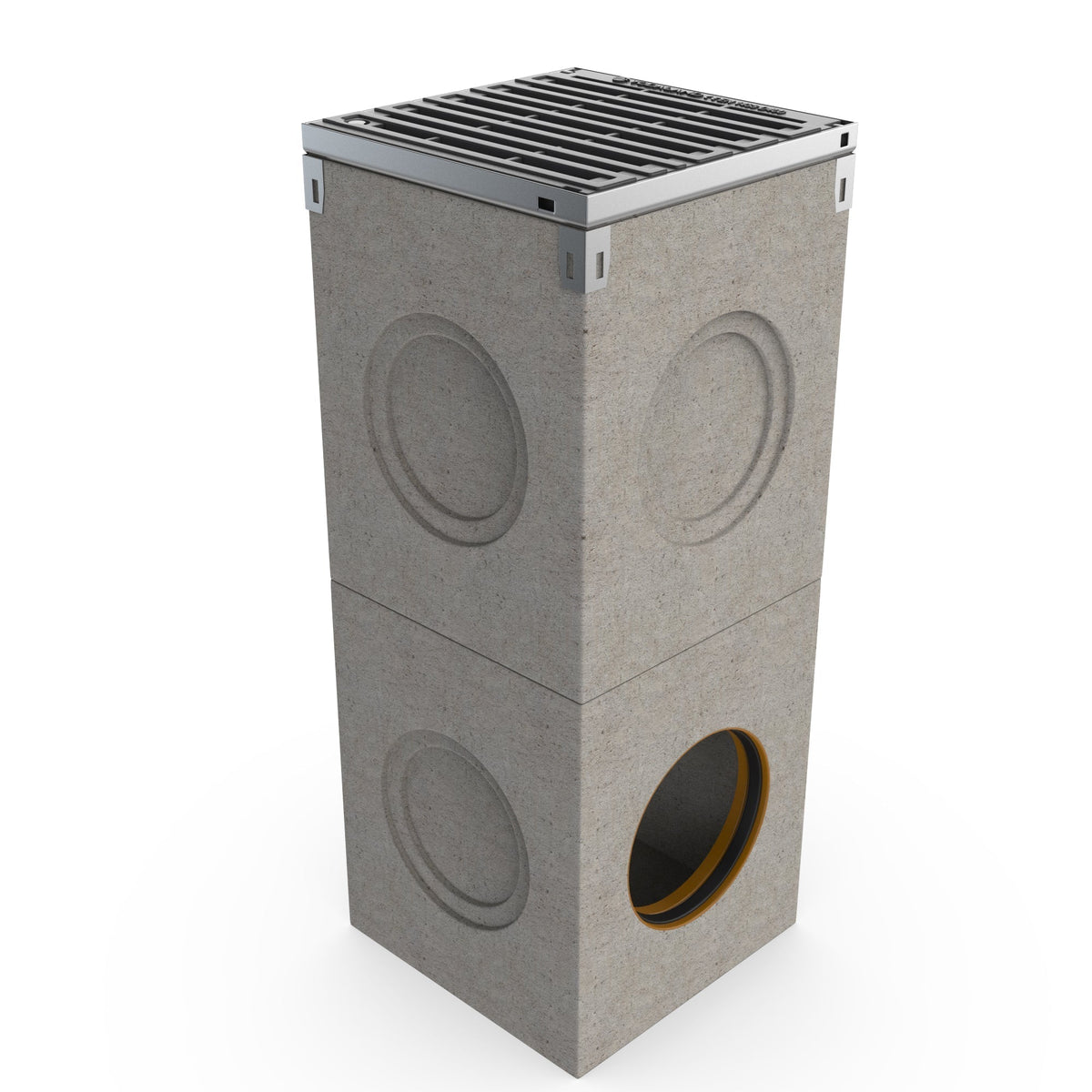
Key Takeaways:
- Catch basins collect water at a single point and move it away through a piped outlet. They're the right solution when water consistently pools in one spot.
- The type of catch basin you need depends on how much water you're managing and what kind of site you're working on.
- The grate is just as important as the basin itself. Material and load class determine whether the installation is safe and built to last.
- Matching both the basin size and the grate to the actual conditions of your site is what separates a system that works from one that fails early.
Water that pools in one spot after every rain isn't a grading problem or a landscaping problem. It's a collection problem. That's where catch basins come in!
Catch basins sit at low points, capture surface water through a grated inlet, and move it away through a connected pipe. It’s a simple concept, but the range of available options is wide enough that choosing the wrong one is easy. This guide walks through the key decisions so you end up with the right system for your specific site.
Why the Right Catch Basin Actually Matters
A catch basin that's too small for the water volume it's handling backs up and overflows, defeating the purpose entirely. A grate rated for foot traffic that ends up under vehicle loads will fail. A plastic basin in a high-traffic commercial area won't hold up.
These are the most common reasons catch basin installations underperform or need to be replaced. Getting this right from the start is a lot less expensive than fixing it after the fact.
The 3 Types of Catch Basins (and When to Use Each)
Catch basins are generally categorized by size and capacity: Type 1, Type 2, and Type 3. Each step up represents a meaningful increase in how much water the system can handle.
Type 1: Residential and Light Applications
Type 1 catch basins are smaller, typically rectangular or circular, and built for residential use. They're the right fit for managing runoff from a single downspout, a low spot in a backyard, or a driveway that pools at one end. Their capacity typically spans around five feet of depth, which is more than enough for standard residential drainage needs.
If your problem is localized and the water volume is moderate, this is where to start.
Type 2: Commercial and Higher Volume Applications
Type 2 catch basins handle larger pipe connections and greater water volume, with a maximum depth of up to 15 feet. They're built for commercial sites where runoff is higher and a Type 1 can't keep up. It’s worth noting that specific local codes may govern Type 2 installations, so check requirements before finalizing your plan.
Type 3: Industrial and High-Demand Sites
Type 3 catch basins are built for the most demanding drainage situations: large volumes of water, heavy debris loads, and sites prone to significant rainfall events. Industrial facilities, large commercial properties, and infrastructure projects are the typical applications. When a Type 2 isn't enough, Type 3 is the answer.
Catch Basin Grate Materials and Load Classes
The basin handles the volume, while the grate handles the load and determines who can safely use the surface above it. These two specs work together. If you get one wrong, the whole system is compromised.
Here's how the main grate materials break down by application:
PPE Plastic: Load Class A
Rated for foot traffic up to approximately 3,372 lbs per foot, this is the right choice for residential walkways, garden areas, patios, and anywhere vehicles aren't part of the picture. It’s lightweight and easy to remove for cleanout.
Galvanized Stamped Steel: Load Class B
This handles light vehicular traffic and covers a wide range of everyday residential and light commercial applications: driveways, sidewalks, porches, and parking areas that see standard passenger vehicle loads. ADA compliant options are available in this material, making it a versatile choice for publicly accessible spaces.
Stainless Steel: Load Class B
This has the same load range as galvanized steel, but it’s built for environments where corrosion resistance matters more. That includes pool decks, coastal properties, chemical-exposed areas, and commercial settings where the finish needs to hold up over time. Stainless also works well in high-visibility installations where appearance is a factor.
Brass: Load Class C
Brass is rated for heavy-duty commercial applications up to approximately 55,000 lbs per foot. It’s built for high-traffic areas that see significant load on a regular basis. It’s also corrosion resistant and durable in demanding environments.
Ductile Cast Iron: Load Class C
This is the standard choice for heavy vehicle applications: commercial properties, parking lots, transport hubs, and anywhere buses or heavy equipment cross the drain regularly. Cast iron handles sustained heavy loads that lighter materials simply aren't built for.
Concrete: Load Class E
When structural strength is the only priority, concrete is the answer. Rated to handle loads exceeding 134,800 lbs per foot, concrete catch basin systems are built for industrial and infrastructure-grade applications: forklifts, steel-wheeled equipment, and commercial solid tire traffic. This is the top of the load class range.
3 Other Factors Worth Considering
1. Debris Management
Any catch basin near trees, landscaping, or areas with leaf fall benefits from a debris basket inside the basin. It captures organic material before it enters the outlet pipe, which is significantly easier to empty than clearing a clogged pipe run. Vodaland's downspout catch basin includes a built-in debris basket and removable grate for exactly this reason.
2. Outlet Sizing
The outlet pipe connected to the basin needs to be sized for the volume the basin is handling. A Type 3 basin connected to undersized outlet piping will back up under peak flow. Plan the full system (basin, grate, and outlet) together.
3. ADA Compliance
If the catch basin is in or adjacent to a publicly accessible pedestrian area, the grate needs to meet ADA standards. This applies to sidewalks, public plazas, parks, and commercial entrances. Check the spec before you order. Retrofitting a grate after installation is avoidable.
Start With the Site, Then Choose the System
The right catch basin isn't the biggest one available or the cheapest one. It's the one that matches the water volume, the load, and the environment of your specific site. Start with how much water you're managing and what's going to be on top of the grate. Everything else follows from there.
If you're working through the right combination for your project, Vodaland's team can help you land on the right spec before anything gets installed.

Leave a comment
This site is protected by hCaptcha and the hCaptcha Privacy Policy and Terms of Service apply.