 Full Catalog PDF

Key Takeaways:
1. Slot drains and trench drains both move water off a surface, but they're built for different priorities and settings.
2. Slot drains win on aesthetics and low profile. Trench drains win on flow capacity and versatility.
3. The right choice depends on how much water you're moving, who's using the space, and how the finished surface needs to look.
4. In some applications, both systems working together is the most effective solution.
Slot drains and trench drains get compared constantly, and the question usually gets framed as one being better than the other. The reality is rarely that simple. They're designed around different priorities, and the one that performs better depends entirely on what the installation actually needs.
Here's a simple breakdown of both systems so you can make the right call for your project.
What's the Difference Between a Trench Drain and Slot Drain?
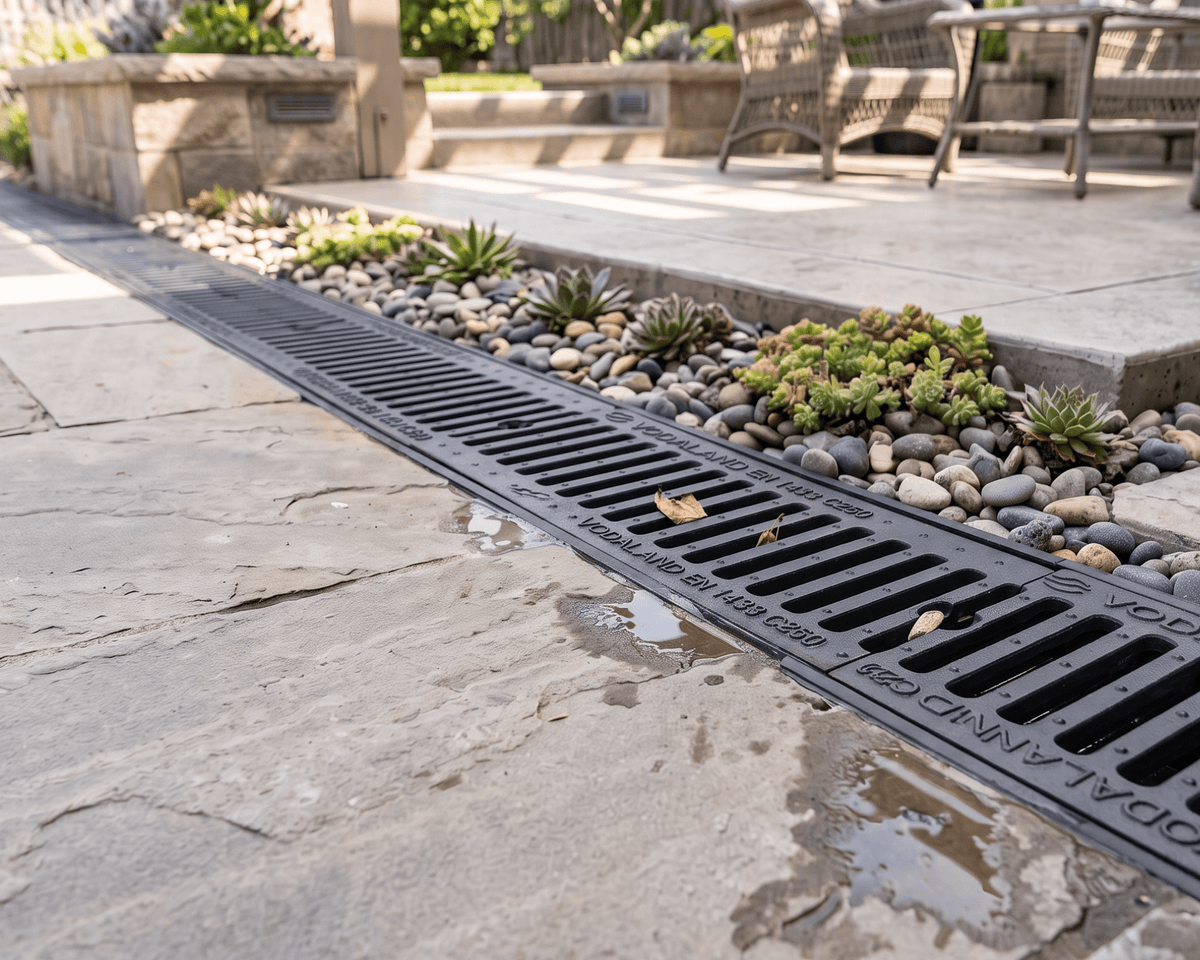
A trench drain is a linear channel system with a visible grated opening across the top. The channel width varies (typically anywhere from 4" to 12" or more) and the grate sits flush with the surrounding surface. Flow capacity is directly related to channel width and depth.
A slot drain is also a linear system, but the surface opening is narrow (typically under an inch wide) with a less visible grate. Water enters through the slot opening and drops into the channel below. The result is a nearly invisible drain line that blends into the surrounding surface.
Trench drains and slot drains have the same fundamental job, but they have different appearances and performance profiles.
Where Slot Drains Have the Advantage
Aesthetics: This is the clearest win for slot drains. The narrow opening creates a clean, almost invisible drain line that suits modern architectural finishes. That includes pool decks, commercial plazas, high-end patios, and contemporary driveways where a visible grate would interrupt the surface design. If appearance is a priority, slot drains are hard to match.
Smaller Grate to Manage: Slot drains use a narrow opening with a smaller or no grate, making it easier to access and clean, which simplifies a maintenance and replacement variable from the equation.
Safe for Bare Feet and Narrow Wheels: The narrow slot opening eliminates the trip hazard concern associated with wider grate openings. For pool decks, spa areas, and barefoot environments specifically, a slot drain is safer by design.
Flush Surface Integration: Slot drains sit nearly flush with the surrounding surface with minimal visual disruption. For tile, pavers, or polished concrete finishes, they integrate more cleanly than a full-width grated channel.
Where Slot Drains Have Limitations
Lower Flow Capacity: The narrow opening that makes slot drains look clean also limits how much water they can accept at once. In high-volume applications such as commercial parking lots, loading docks, and heavily trafficked driveways, a slot drain may not move water fast enough.
Debris Management: A narrow opening collects debris more readily than a wider grated channel, and clearing it requires more attention. Leaves, sediment, and organic material can partially block the slot opening in ways that reduce performance between cleanings.
Less Versatility Across Load Classes: Slot drains work well in pedestrian and light vehicle settings. For heavy vehicle applications such as industrial sites and transport hubs, a trench drain with a properly rated cast iron or ductile iron grate has a broader load class range.
Where Trench Drains Have the Advantage
Higher Flow Capacity: A wider channel moves more water. In applications with high runoff volume such as large impervious surfaces, heavy rainfall environments, and industrial sites, a trench drain handles peak flow that a slot drain can't keep up with.
Grate Options Match the Application: Trench drains pair with a full range of grate materials and load classes: plastic for light residential, galvanized steel for standard foot traffic, stainless for corrosive environments, and cast iron for vehicle loads. That flexibility makes trench drains adaptable across a much wider range of applications.
Easier Access for Cleanout: Removable grates give direct access to the full channel interior. For applications with high debris load (near trees, landscaping, or food service areas) that access makes maintenance faster and more thorough.
Better for Complex or High-Volume Sites: Large commercial projects, industrial facilities, sports complexes, and airport infrastructure all tend to spec trench drains because the combination of flow capacity, load class range, and cleanout access is hard to match at that scale.
Where Trench Drains Have Limitations
More Visible: A grated channel is always going to be more visible than a slot drain. In settings where the finished surface appearance is a priority, a full-width grate can feel out of place, particularly in high-end residential or architectural commercial projects.
Grate Maintenance: Removable grates are an advantage for cleanout but also a variable that needs managing over time. Grates can shift under load, wear over years of use, or need replacement—particularly in high-traffic vehicle applications.
Tripping Hazard in Some Settings: Wider grate openings require attention to ADA compliance and heel safety. Getting that spec wrong creates both a safety risk and a liability issue, as covered in detail in our ADA vs. heel proof grate guide.
How to Choose Between Slot Drains and Trench Drains
Run through these questions and the answer usually becomes clear:
Is appearance a top priority?
If the finished surface needs to look clean and uninterrupted, go with a slot drain. Pool decks, modern patios, and architectural plazas all benefit from the narrow, nearly invisible opening a slot drain provides.
How much water does the surface need to move?
High volume applications, large surface areas, and heavy rainfall environments call for a trench drain. For moderate residential or light commercial flow, either system works.
Will vehicles cross the drain?
Heavy vehicle traffic requires a trench drain with a load-rated cast iron grate. For passenger vehicles on a residential driveway, both systems are viable depending on the slot drain's specific load rating.
Is debris a consistent issue?
Near trees, landscaping, or food service areas, a trench drain is the better choice. Removable grates give you direct access to the full channel interior, making cleanout faster and more thorough.
Is this a barefoot or dress-shoe environment?
For pool decks and spa areas, a slot drain removes the tripping hazard concern entirely. For commercial pedestrian zones where footwear varies, a trench drain with a heel proof grate covers both safety and compliance.
Sometimes, Both Systems Make Sense Together
Some projects call for both. A commercial pool facility might run slot drains around the pool perimeter for aesthetics and barefoot safety, with trench drains handling the higher volume runoff at the perimeter of the deck or in the surrounding hardscape.
A high-end residential property might use a slot drain across the driveway apron for a clean finish and a trench drain along the property edge where flow volume is higher.
Treating the two systems as complementary rather than competing gives you more flexibility to solve the full drainage picture rather than forcing one solution to do everything.
If you're working through the decision for a specific project, Vodaland's team can help you land on the right system before anything gets installed.


Leave a comment
This site is protected by hCaptcha and the hCaptcha Privacy Policy and Terms of Service apply.